

In my Goddesses In Love series—as well as my current book—I needed to visualize the Underworld as a character. And what better way to do that than by doing one of my favorite things… research! Since I generally pass on what I learn, you get to benefit from what I found out—a win-win, if you ask me. But perhaps only a lifelong learner thinks like that, so if chatting about the Underworld in various myths isn’t your jam, this post is not for you.
Still here? Wonderful! You are my people…Let’s do this!
In my story Web Of Lies, the Ancient Greeks inspired the Underworld I created, right down to the ferryman. But for the purposes of this post, I thought it would be fun to peek at a few other mythological viewpoints. We’ll explore Greek/Roman, Egyptian, Norse, and even angels and demons, because it’s quite possible my current heroine has a brooding dark angel in her future.
So, without further delay, join me around the world for a journey below… to the Underworld!
Greek & Roman Mythology
In Greek and Roman myths, the Underworld is a landscaped realm, complete with rivers, gates, and natural rules for balance. Hades is the ruler of the Underworld, given that title by drawing lots when he, Zeus, and Poseidon divvied up the earth. While the character Hades in the animated Disney Movie, Hercules, feels as if he drew the short straw, my feeling is he actually got the better deal. I mean he ruled over an entire sub-kingdom that he got to himself where no one could bother him, and only a select few of his family members could enter, while his brothers had to split the upper realm. Not a terrible deal if you ask me, especially considering all the world has to offer.
In my series, Hecate has a big role to play in Hades and Persephone getting together. When I was researching Hecate for my Goddesses of Witchcraft posts, her character intrigued me, and my Muse ran with it. What is so interesting about her is that she is one of the original Titans, and was one of the key players in Zeus’ success in over throwing his father. While she is given a “place of honor” in his pantheon, I like to think it is more so that he’s afraid of what she could do to him. She is tied to the Underworld, one of the only Goddesses that can travel freely between it and the earth realm, and I find that interesting. She was also portrayed as being friends with Demeter, and a godmother to Persephone, which is where my story grew from.
Key Characters:
- Hades – The ultimate ruler, overseeing the dead and brother to Zeus & Poseidon.
- Persephone – Queen of the Underworld; her story explains the changing of the seasons. Most know or have read a dark version of how she became Queen, my version is a little more “fluffy” as one reviewer described it.
- Hecate – One of the original Titans, able to travel freely between worlds. She’s a friend to Demeter and godmother to Persephone. In my story Love For All Seasons, Hecate plays a pivotal role in bringing Hades and Persephone together and sets them up on a blind date so to speak.
- Morpheus – The god of dreams and able to take on the form and speech of men. He is depicted as delivering news to royalty via their dreams. He is the leader of the Oneiroi, the demons (or personifications) of sleep and, when not working, slept in a room filled with poppies. The flower’s connection to opium is how the drug morphine was named. I get more into his character in my book Web Of Lies.
The Underworld is traveled via five rivers:
- The Styx, which separate the worlds of the living and dead, was the river of hatred and unbreakable oaths. The gods were often depicted as taking vows by its waters and was the river that ran from the outside world inward. Just inside the entrance was a three-headed watchdog named Cerberus who prevented anyone from leaving the kingdom.
- The Acheron, known of the river of sorrow and pain. This is where the souls go to catch their ride with Charon, the ferryman. Passage requires a coin that was placed on the lips of the dead during the funeral, and souls without one would be stranded on the shore of the river forever trapped between the living and dead.
- The Cocytus, the river of lamentation and wailing. This would be where those who did not have a coin would hang out for eternity and ,apparently, stand around and sob.
- Lethe is the river of oblivion and forgetfulness, and where the souls drink from to forget their past and prepare themselves for a possible rebirth.
- And the Phlegethon, the river of fire, and is the most likely route to Tartarus where the baddies, including the Titans, hung out. The Elysian Fields is really where you wanted to be as it is most similar to the Christian’s idea of heaven.
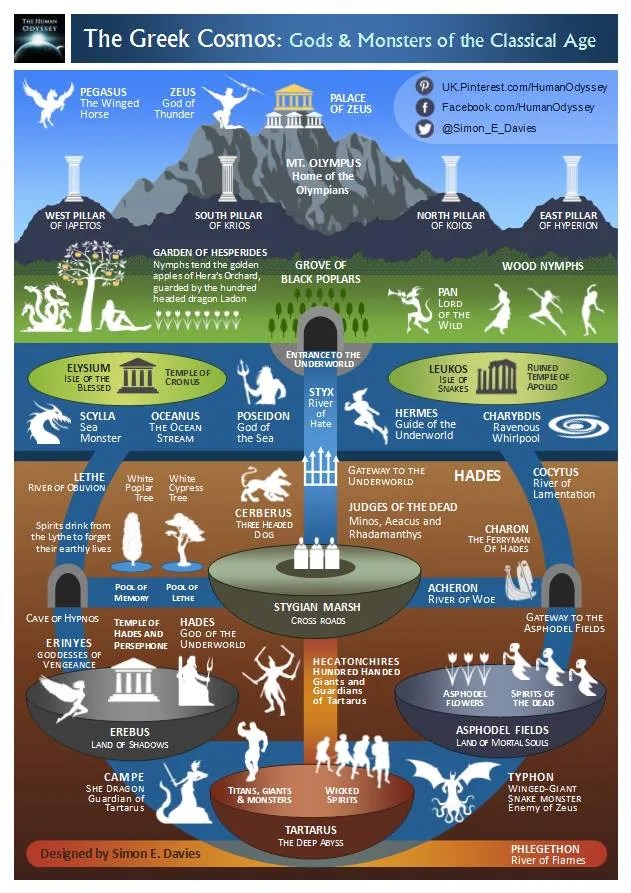
Books in my Goddesses In Love series which include descriptions of the Underworld in the most detail are Web Of Lies (Book 4) and Pandora’s Curse which is a free book you can download here: https://payhip.com/b/9yQrM
Egyptian Mythology
The Egyptian Underworld, or Duat, is a magical, mysterious realm ruled by Osiris after his death at the hands of his brother Set (Seth). Unlike Greek myths, the Underworld in this mythology isn’t assigned at birth—it’s earned or claimed through cosmic events, or perhaps by opening and reading from the Book of the Dead.
Not sure about you but the only cosmic event I want to see is Mummy 4 when it comes out… so excited Brendan is having his moment! Missed him! And moving on…
Unlike the Greek & Roman culture, where Hades started out as the God of the Underworld when the roles were distributed, the Egyptian Underworld got its ruler in a little more colorful way. The Duat, or Tuat as it was also known, was ruled by Osiris after he was killed by his jealous brother Set (Seth) and cut into, lets just say, several pieces.
Until he was killed, Osiris and his wife, Isis, ruled over a peaceful and prosperous Egypt, but Set wanted to be ruler, so he came up with a plan. I wrote about the myth in an earlier post about Isis, which you can read here, but basically Set created a beautiful casket which he convinced his brother to “try out” and once Osiris got in there, it was all over.
Set dropped pieces of Osiris all over Egypt, and Isis set off to gather them up and piece them back together Frankenstein style. Similar to the Greek myth about Kronos, there was a “special” piece of Osiris missing, and Isis and her sister fashioned one out of gold so she was able to get pregnant with their son Horus. Because Osiris was no longer whole he could no longer stay in the earth realm, so he chose to go to the afterlife and rule there. Isis stayed in hiding on earth until Horus was of age to rule and defeat his nasty uncle, then continued her work restoring souls in preparation for their journey to the afterlife and becoming a prominent goddess in the culture.
Key Characters:
- Osiris – Ruler of the Duat, resurrected after his dismemberment. He was the god of judgement and fertility. In the afterlife there are 42 divine judges that decide the fate of the departed.
- Isis – His wife, who restores him and conceives Horus, ensuring the continuity of life and kingship. She was the goddess of the afterlife.
- Set (Seth) – Jealous brother and antagonist, who kills Osiris to claim power. He was known as a chaos god, and after his battle with Horus becomes a protector to Ra.
- Anubis – weighs the heart of the deceased. Depicted with the head of a jackal.
- Ma’at – Goddess of order and the feather that is weighed against the heart.
- Ammit – eats the hearts and souls of those who do not pass the “weighing of the heart.”
- Horus – Son of Osiris and Isis and defeater of Set. During the battle his eye is damaged and when put back together became a powerful symbol in the Egyptian culture. The Eye of Horus, and the Eye of Ra, were sometimes used interchangeably.
- Ra – The Sun god.
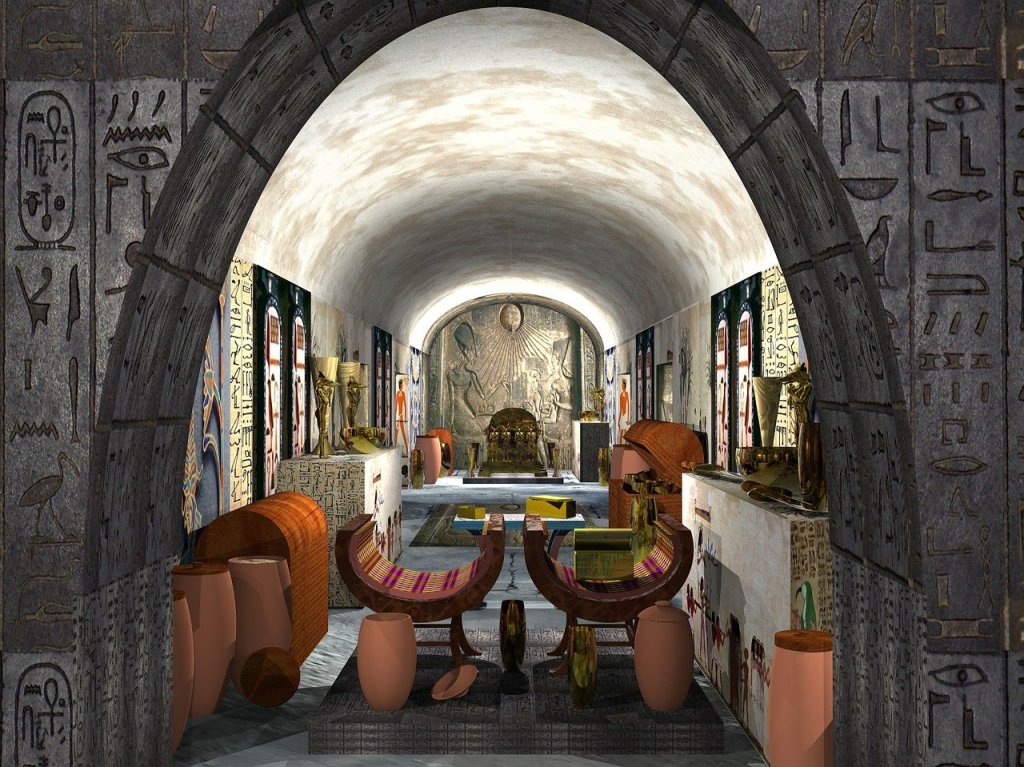
The Duat is a journey as well as a destination, with dangers and magical tests for souls. Osiris’ resurrection symbolizes eternal life, and his realm represents the cyclical nature of death and rebirth. The sun god, Ra, must journey through trials and hardships within Duat every night only to be reborn each day, further cementing the notion of rebirth.
I went to a pretty cool exhibit a few years ago that send me down the rabbit hole of research for Isis and some possible mythology retellings, and if you ever have anything similar in your area it is worth the price of a ticket. I find that the immersive experiences can really be fun and really help get your into the mood for some creativity. Here is the one I checked out in the Detroit area: https://immersive-kingtut.com/detroit/
Norse Mythology
In Norse myths, the Underworld is less about moral reward or punishment and more about fate, inevitability, and the natural cycle of life and death. Except for Loki… he always seems to be chasing something he shouldn’t have. Not sure why, since being the god of chaos and mischief seems to be a pretty good gig.
Another cutie patootie… Anyway, Loki’s daughter is the ruler of Helheim, which is what the Norse called the Underworld. She is the balance between the living and the dead and casts impartial judgement, unlike her father who feels he got the short end of the stick.
Unlike the “above below” set-up of many cultures, Norse mythology handles things a little differently. Their mythology breaks up reality into several worlds, each with their own identity and culture, which all surround a sacred ash tree known as Yggdrasil. This tree is central to the cosmos and connects all things. Helheim is where those who lack courage and die in dishonor will go, while those chosen by the Valkyries will sit with the gods in Valhalla or Freya’s Sessrumnir, located in Asgard.
A quick summary of the worlds:
- Hel – Home to Hel and her familiars. The final abode of all the dead, save for those chosen to sit and feast with the gods. She will rally those in her realm to fight the Aesir and Vanir tribes at the time of Ragnarok, along with her brother Fenir the wolf, and Jormungand the serpent.
- Niflheim – A place of frost, ice, snow, and mist. I envision it as the “North Pole” of the cosmos. The mouth of Helheim is found here guarded by Nidhogg the dragon. It is so cold and inhospitable that not even the frost giants live here. The spring Hvergelmer, which is the source of all life, feeds one of the roots of Yggdrasil.
- Nidavellir – Home of the dwarves who are known for their craftwork and weaponry as well as Svartalfheim which is home of the black elves. The land lies beneath the surface of Midgard and is a maze of underground tunnels.
- Muspelheim – A place of fire and home to the fire giants. Surt, who will one day set fire to the world tree, dwells here. The flames here melted Niflheim ice and in doing so created life in the Nine Realms. The fire here is prophesized to bring destruction of the sacred tree during end times.
- Midgard – Home to mortal humans, positioned in the center of the conflict of the other 8 realms. Of course we are… Apparently at the time of Ragnarok our realm with sink into the sea. Good times.
- Vanaheim – Home of the Vanir tribe of “lesser” gods, associated with fertility and nature, and homeland to Freya. They are masters of witchcraft and prophecy.
- Jotunheim – Home of the frost giants and an inhospitable climate. Although some gods have been known to dabble with the “inhospitable” giantesses there.
- Alfheim – Home of the bright elves and ruled by Freya’s twin brother, Freyr, as part of the peace treaty after the Aesir-Vanir War between the two god tribes.
- Asgard – Home of the Aesir tribe of gods and home to Odin, Freya, and Thor to name a few. It is connected to Midgard via the rainbow bridge, which is the only way in or out, and this realm is considered as close to heaven as you can get. This is where the chosen souls go to feast with the gods. This land is central to the universe. It is here where Odin gathers souls to feast in Valhalla until the day they are needed to fight during end times, also known as Ragnarok.
Key Characters:
- Hel – Daughter of Loki, ruler of Helheim. She’s half-living, half-dead, and carries out cosmic order with impartiality. She will be one of the main players in end times.
- Odin (Possibly Odr) – God of wisdom and war, often interacts with the dead, selecting fallen warriors for Valhalla. Husband to Frigg who is known as the Queen of the Gods and associated with marriage, motherhood, and fertility.
- Nidhogg – A dragon gnawing at Yggdrasil’s roots, representing decay and the inevitability of death.
- The Einherjar – Brave warriors brought to Valhalla after dying in battle.
- Freya (Possibly Frigg) – She too functioned as the fertility and harvest goddess, with ties to wealth and magic, but is shown separate from Frigg who is Odin’s wife. She was from the Vanir tribe and brought to Asgard to live along with her twin brother as part of a peace treaty after the Aesir-Vanir War. Her husband was Odr who was often absent from her side, although she bore him 2 children. Freyja’s magic included her ability to shape-shift and she had a magical cloak made of feathers that gave the gift of flight to anyone who wore it. She was also known to ride around the cosmos in a carriage drawn by her cat familiars, and was also fond of rabbits, boars, and oxen.
Themes & Features:
- The dead are categorized by manner of death, not morality. Warriors who die honorably are rewarded by being put in a festive “holding pattern” until they are called to fight in end times. Hopefully they haven’t feasted “too much” when that time comes!
- Helheim is cold, misty, and forbidding—a realm to survive rather than conquer. The road to get there is long and must be traveled by each soul.
- Rivers, thresholds, and mystical creatures mark the journey, similar to Hades’ underworld.
I read mostly Greek mythology growing up as a kid, so Norse myths are on my list, especially considering how much I love the Marvel franchise. Anyone who can steer me in the right direction when it comes to what to read first, please let me know in the comments! And I’m curious, what did Marvel get right and wrong? Also, found an amazing resource on YouTube who I linked to below!
Angels & Demons
Finally, the world of angels and demons introduces a moral and spiritual dimension to the Underworld. Unlike Greek or Egyptian underworlds, this realm is deeply entwined with ethics, temptation, and rebellion. Good vs Evil… with huge consequences.
Okay I realize he wasn’t an angel, just trying to earn his way into heaven, but this is the type of character I think of when writing my current hero. I’ll have to say no to the smoking though .I loved Keanu in this movie by the way which starred another favorite, circling back to The Mummy reference, Rachel Weisz.
Dante’s Inferno describes 9 circles of hell, which I would imagine is the version most believers think of if they put any thought to it. Or perhaps it is just a place of fiery internal torment from which there is no escape. Either way it doesn’t sound like a nice place. The major difference between the underworld in the ancient world, and the Christian underworld is location, location, location. There is the idea in Christianity that good goes up, and bad goes down, into 2 distinct places with 2 distinct rulers. With the ancients there was one underworld that was subdivided and your area was selected based on your life here on earth.
Key Characters:
- Lucifer/Satan – The archetypal fallen angel, ruler of Hell. Once upon a time he was God’s favorite. His name means “light-bearer or light-bringer” and in classical mythology the name was associated with the planet Venus at dawn aka “morning star.”
- Azazel, Belial, and other demons – Specialists in temptation, forbidden knowledge, or punishment. Azazel may or may not have given women access to cosmetics and other beauty products.
- Archangels (Michael, Uriel, Raphael) – Guides and protectors, sometimes escorting souls or challenging mortals. Michael is the chief of the angels and archangels and is given credit for “defeating” Satan.
- Grigori / Watchers – Angels who came to Earth, bridging the divine and infernal. Depicted as messengers, or sometimes “fallen” when having relations with humans, these watchers live among us and are our connection to the divine. I can’t help but picture the scene at the end of City Of Angels here… and if you haven’t seen it… so good, so sad, and maybe hasn’t aged well, can’t remember. But… memorable even after all these years.
- The Four Horsemen – Represent conquest (white horse), war (red horse), famine (black horse), and death (pale/greenish). They are figures in the Book of Revelation,
Themes & Features:
- A moral battleground as well as a location. Justice is carried out post-mortem as the soul is everlasting.
- Layered hierarchies of power, domains, and duties. Good angels stand with God, angels that rebelled against God’s authority are consider “fallen” and side with Satan.
- Punishment, temptation, and ethical struggle are central. Punishment is based on the sins made during the life you live.
So as much as I knew about Norse Mythology, I know even less about Demonology and Angels, except what I learned in Sunday school of course. I am looking for resources here as well for my current WIP, so comments giving me direction are appreciated!
Wow! That was a lot of stuff to unpack and I have hardly touched the surface of each of these topics! It is always interesting though to learn how ancient cultures viewed the world and how it all flavored the belief systems we have in place today. I will never understand the whole living and dying for the belief, but that is a whole different topic. Suffice to say, I’m a lover not a fighter, which is why I write Romance!
If you would like to go a little further down the rabbit hole, here are some links I came across that had some good material. In the meantime, take care of yourself and the ones around you! XO
Resources & References
D.A. Henneman, Mythical Creatures & Goddesses Posts
Egyptian References:
https://naturalhistory.si.edu/exhibits/eternal-life-ancient-egypt
https://www.egypttoursportal.com/en-us/eye-of-horus-and-eye-of-ra/
Norse References:
https://vikingr.org/norse-cosmology/nine-realms-of-norse-mythology
Demonology References:
https://www.britannica.com/topic/Lucifer-classical-mythology
https://biblehub.com/q/who_are_the_grigori_angels.htm
All rights reserved, including the right to reproduce, distribute or transmit in any form or by any means. For information about subsidiary rights, please contact the author at saraybooksllc@gmail.com.

 D.A. Henneman - Romance Author